Medium-Term Management Plan
We would like to provide an overview of our latest Medium-term management plan 2028.
Latest Medium-Term Management Plan
- Announced May 8, 2026
Medium-Term Management Plan 2028: Overview
Future Vision
Future Vision
For more smiles.
A leap toward becoming a “Social Value Creation Company”
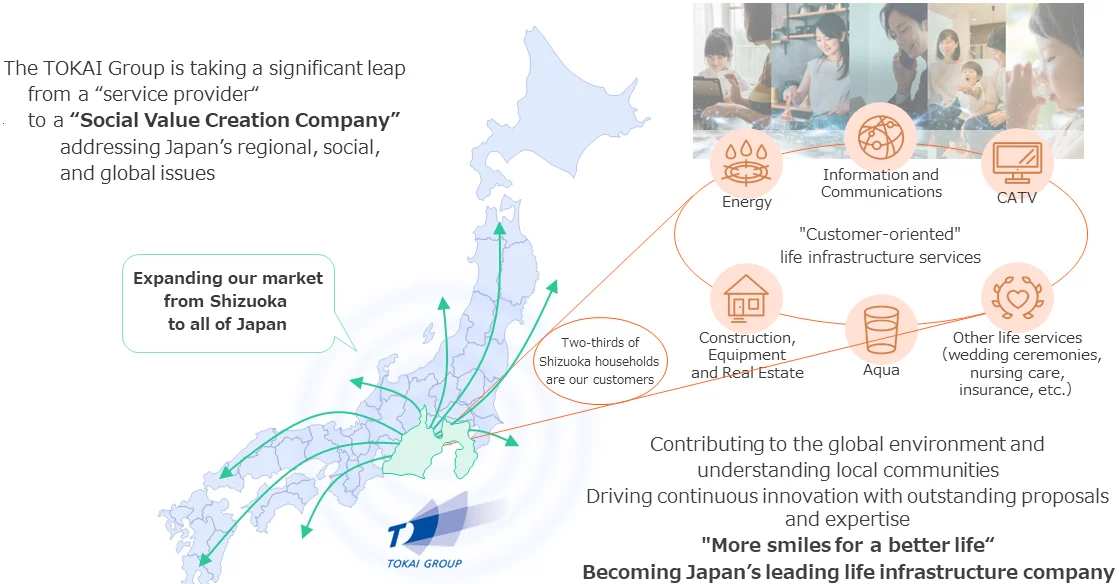
Our company has been providing comprehensive lifestyle services for our customers, and in Shizuoka Prefecture in particular, two out of three households use services from our group.
As we expand this "Shizuoka Model" nationwide, we aim not only to firmly support the foundation of our customers' lives, but also to contribute more than ever to solving regional and social issues in Japan, as well as global challenges. Through these efforts, we strive to become a "social value creation company."
In addition to understanding and contributing to the environment and local communities, our future vision is to become Japan’s leading company in living infrastructure by further strengthening our capabilities in proposals and technology, which are our core strengths.
Sustainability Strategy: Four Pillars
Formulation of the sustainability strategy—Four Pillars—to leap toward becoming a “Social Value Creation Company”
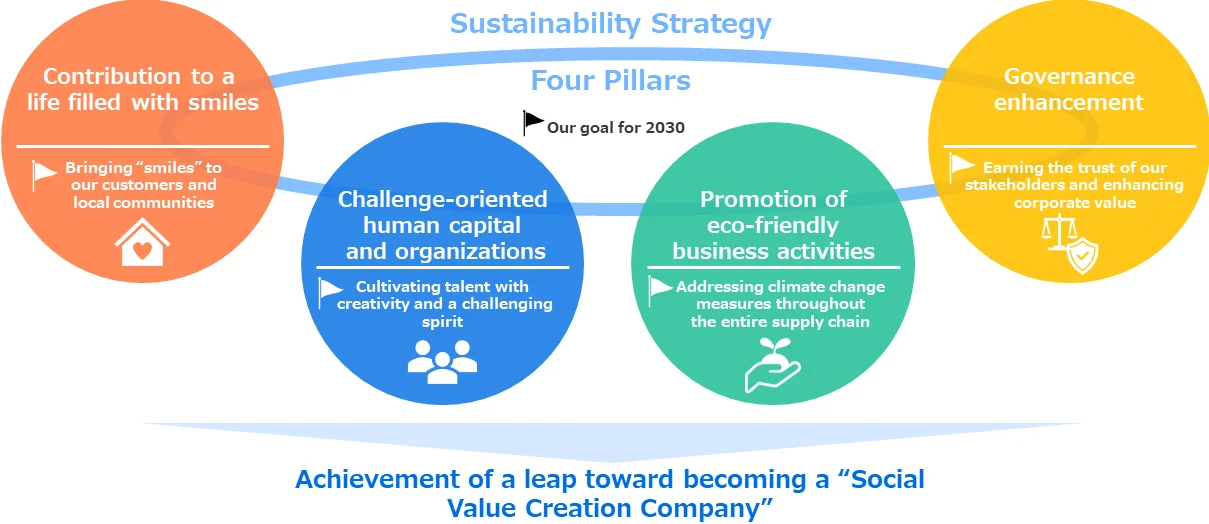
The following are the four newly established pillars of our Sustainability Strategy.
- ・Contribution to a life filled with smiles
- ・Challenge-oriented human capital and organizations
- ・Promotion of eco-friendly business activities
- ・Governance enhancement
For each pillar, we have defined our vision for 2030, and we will work towards its realization.
For details, please refer to the press release "Notice Regarding the Review of TOKAI Group Materiality (Key Issues) " [PDF:537KB]published on May 8, 2026.
Key Points of the Medium-Term Management Plan 2028
Long-term vision
Setting “achievement of 15% ROE in FY2030” as a long-term target
driving both business growth and greater shareholder value
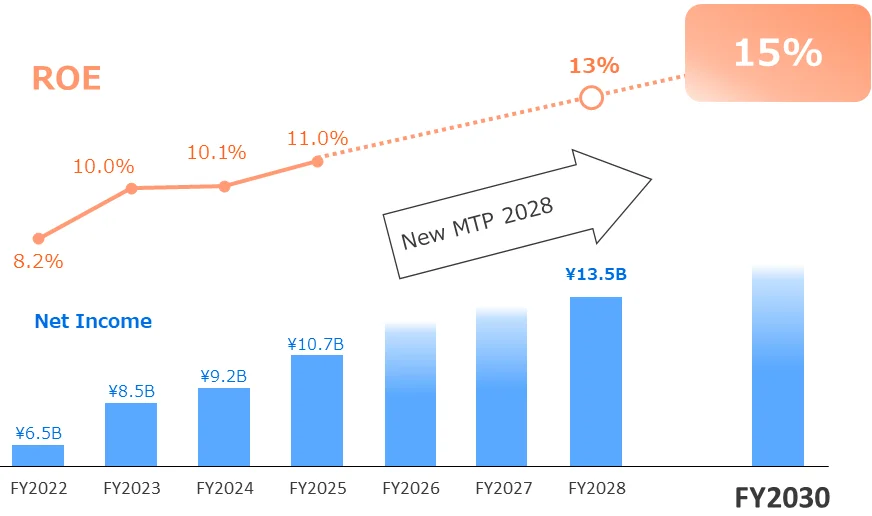
As an indicator driving both business growth and the expansion of shareholder value, we aim to achieve an ROE of 15% in fiscal year 2030.
To achieve this goal, a significant leap exceeding our previous growth pace will be required over the next five years. By executing our business strategy as well as our financial and capital strategy, we will strive for accelerated growth.
Quantitative targets of the medium-term management plan
Aiming for record-high ROE of 13% in FY2028 through the attainment of linked targets
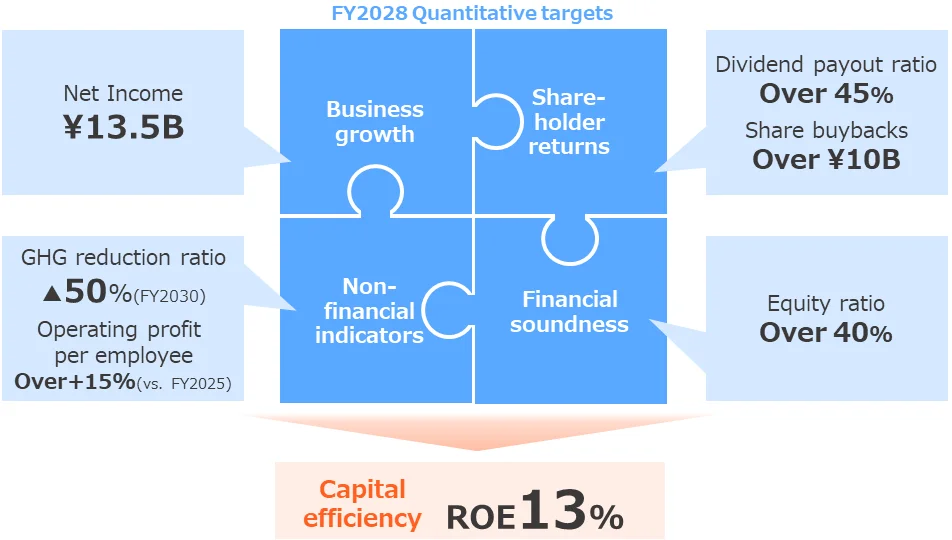
In terms of business growth, we will increase net income from 10.7 billion yen in fiscal year 2025 to 13.5 billion yen in fiscal year 2028.
Regarding shareholder returns, our targets are a dividend payout ratio of over 45% and acquisition of treasury shares totaling over 10 billion yen over three years.
For financial soundness, we aim to maintain a capital adequacy ratio of over 40%.
As for non-financial indicators, in the environmental field, we aim to achieve a GHG reduction rate of 50% by 2030; and in the area of human capital, we plan to increase operating profit per employee by 15% compared to fiscal year 2025.
By achieving these targets, we aim to reach a record-high ROE of 13% in fiscal year 2028.
Overview of the medium-term management plan
Maximization of corporate value through the dual engines: business profit growth and shareholder returns enhancement, underpinned by a strengthened management foundation
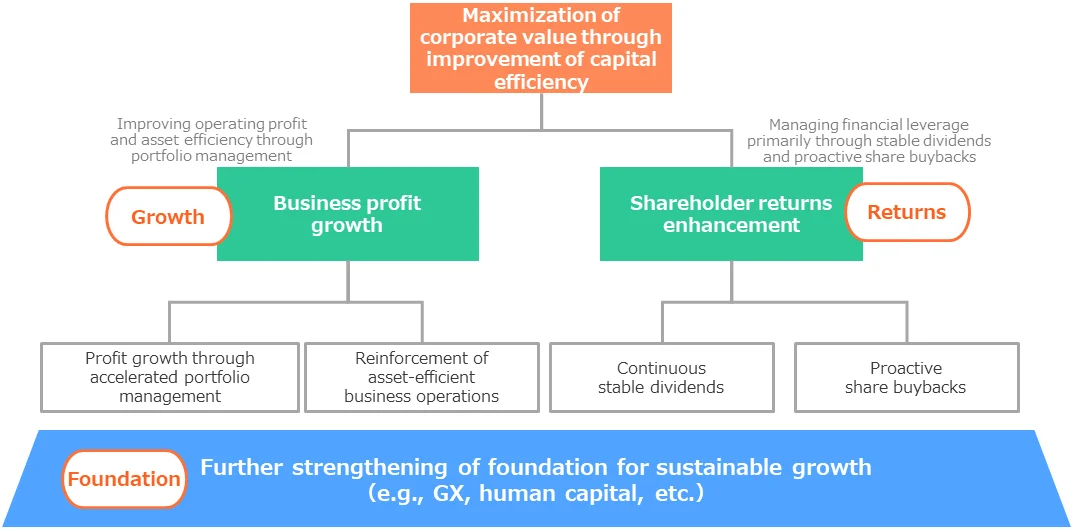
By simultaneously expanding business profits and strengthening shareholder returns, we will vigorously promote improved capital efficiency and the maximization of corporate value.
Business strategy
Business growth strategy
"Triple Accel" Strategy–driven accelerated business growth
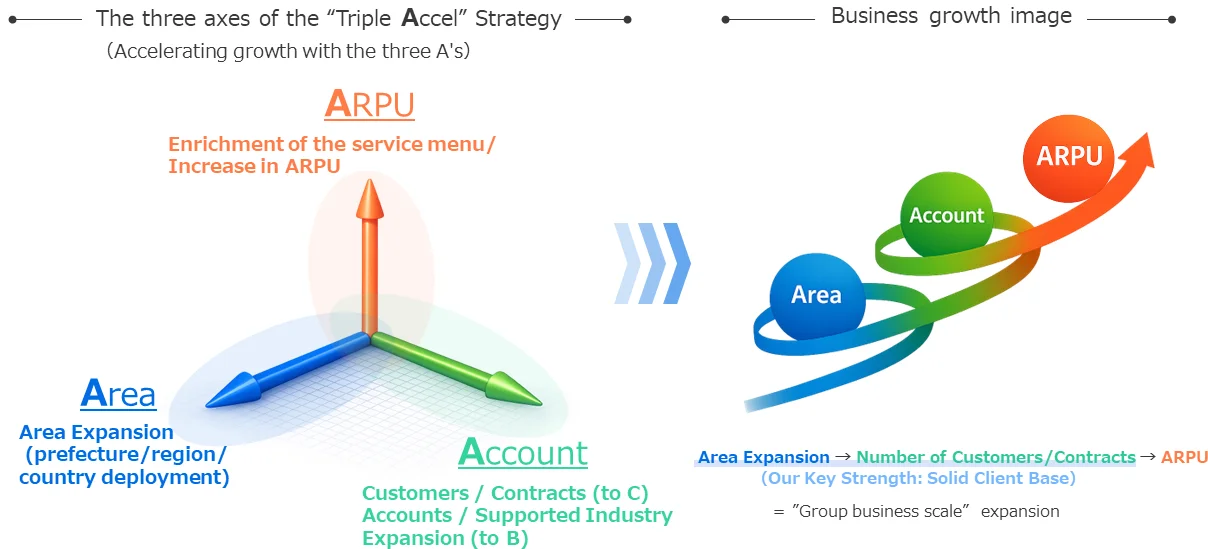
For business expansion, simultaneous growth in three directions is essential: “expansion of Area,” “increase in Accounts,” and “improvement of ARPU.”
Since all of these begin with the letter “A,” we have named this the “Triple Accel Strategy,” through which we will accelerate growth in all three directions.
Based on the "Triple Accel Strategy," we will simultaneously expand our business foundation and strengthen our profitability, leading to sustained growth.
Business Portfolio Policy
Group-wide growth acceleration through portfolio-based investment centered on our three key businesses
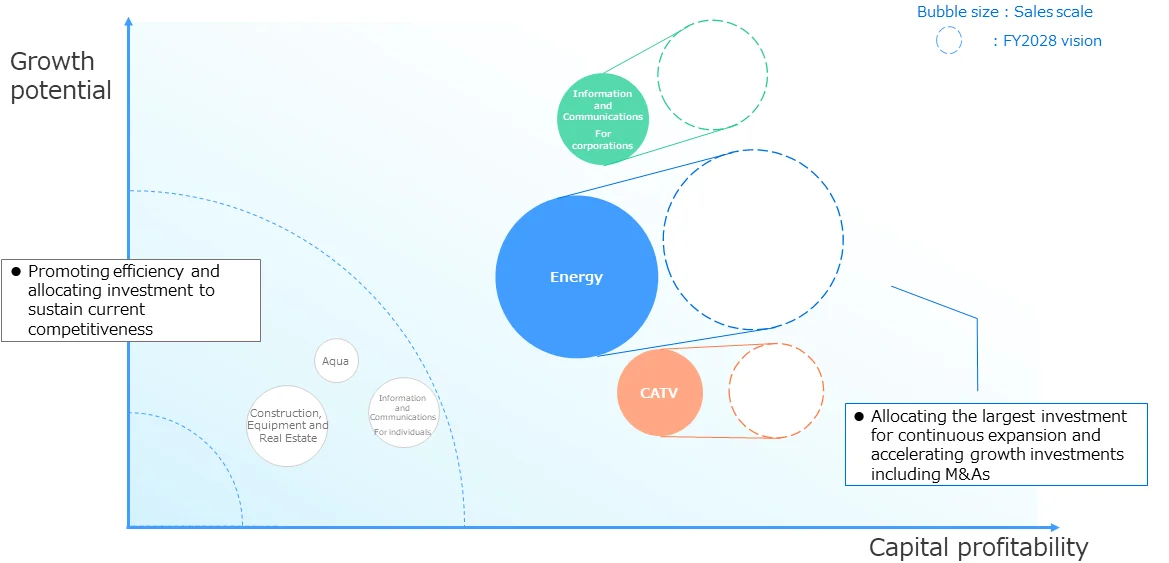
Our group has engaged in a variety of businesses and has been promoting business portfolio management.
Going forward, we will continue to actively allocate management resources to business areas with growth potential, based on our policy of "selection and concentration."
In particular, we position the energy business, corporate information and communications business, and CATV business as growth areas, and aim to expand their scale through active investment such as M&A.
Financial and Capital Strategy
Balance sheet management policy to improve capital efficiency
Promotion of balance sheet management for improved capital efficiency
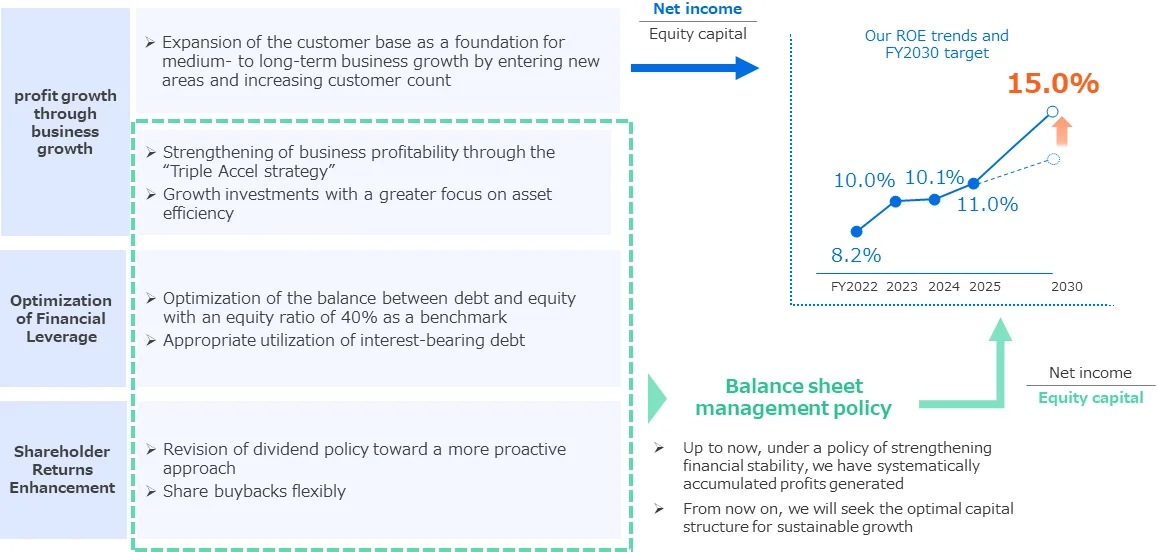
Until now, we have prioritized financial stability and steadily accumulated profits. Going forward, we will also place a strong emphasis on capital efficiency, aiming to achieve an optimal capital structure.
Capital Allocation
Stable profit growth and strategic allocation for ROE improvement
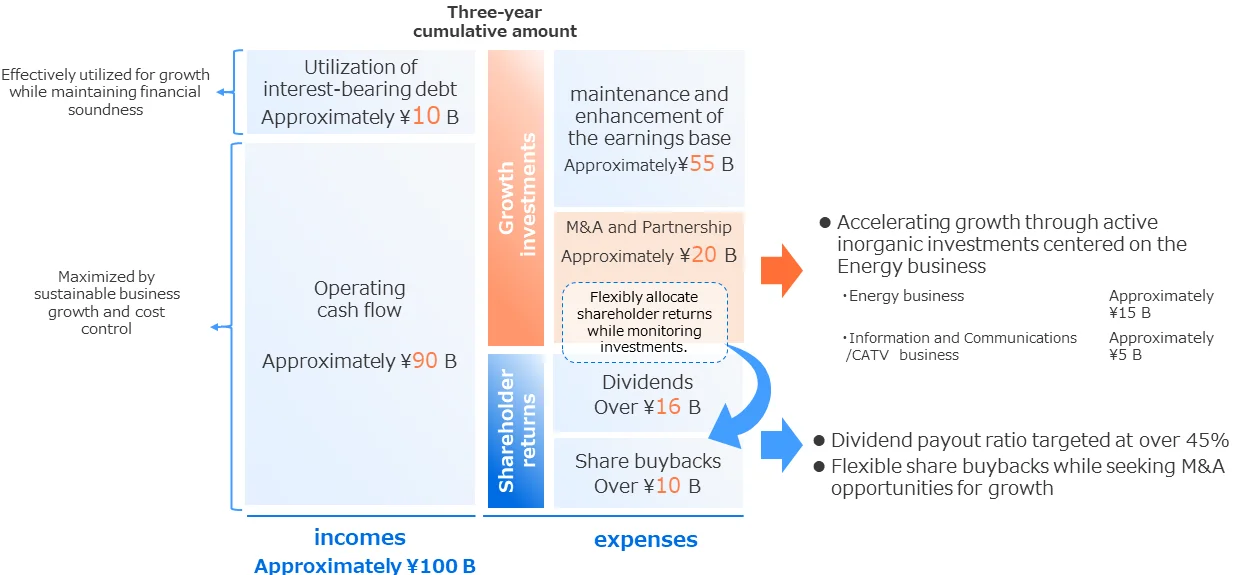
In addition to operating cash flows of approximately 90 billion yen over three years, we plan to utilize interest-bearing debt to secure a total of 100 billion yen in cash.
On the other hand, we will allocate a total of approximately 75 billion yen to growth investments. Of this amount, 55 billion yen will be allocated to maintaining and strengthening our earnings base, and 20 billion yen to inorganic growth investments, mainly in the energy business.
As for shareholder returns, we expect to allocate approximately 26 billion yen through dividends and the acquisition of treasury shares.
Depending on the progress of growth investments, we plan to flexibly redirect funds to shareholder returns.
Sustainability Strategy
The connection between sustainability strategy and enhancement of corporate value
Promotion of the sustainability strategy in conjunction with further enhancement of corporate value
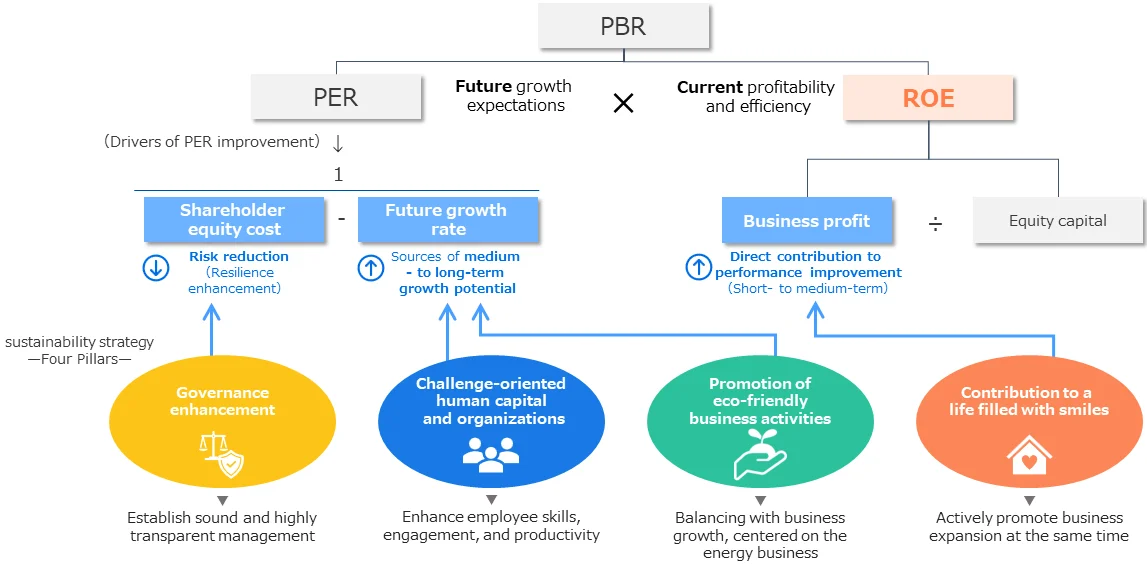
Through strategic initiatives based on the four pillars of our Sustainability Strategy, we will achieve corporate growth, improved profitability, and ultimately enhance our corporate value.
Overall Picture of GX initiatives
Achievement of both “environmental value creation” across the entire supply chain and our company’s “business growth”
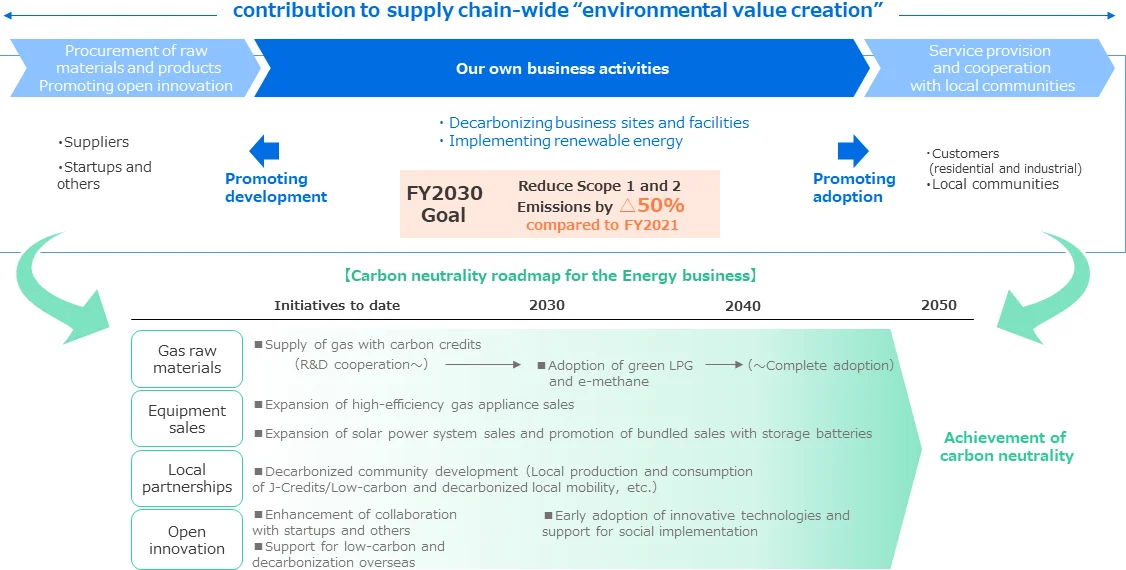
Toward our GHG emission reduction targets for fiscal year 2030, we will work not only on our own business activities, but also on the "creation of environmental value" throughout the entire supply chain, striving to balance this with business growth.
Human Capital and Development Policy
Enhancement of corporate value through productivity improvement driven by human resource strategies and human capital investment
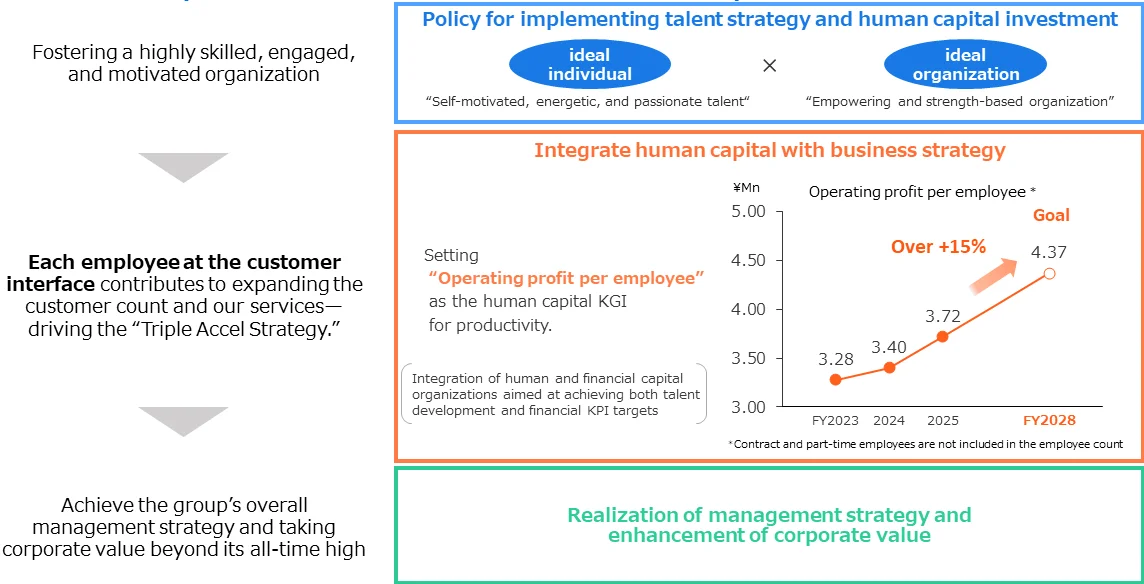
We regard human capital as an important element of our management, and have implemented various initiatives.
This time, in order to clearly define its connection with our management strategy and further strengthen this linkage, we have established "operating profit per employee" as a new key goal indicator (KGI) for human capital.
Each employee will actively engage with customers, quantifying the outcomes generated by the "Triple Accel Strategy" and directly connecting these results to the company's growth.
DX Strategy and Initiatives
Continuous improvement of user experience through a cycle of data collection, analysis, and utilization
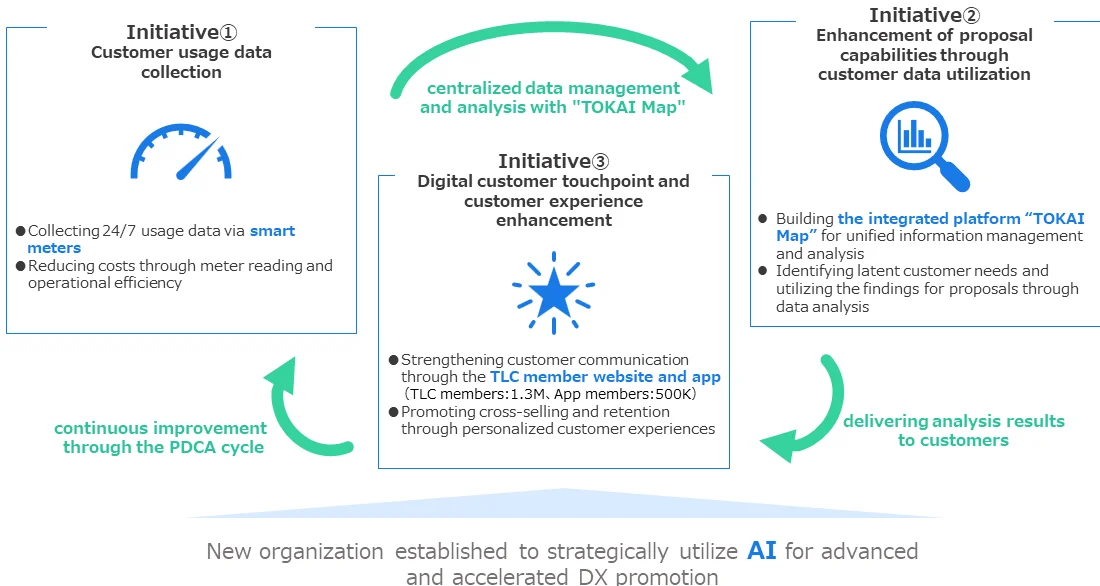
Our group develops a wide range of businesses and centrally manages customer information using the "TOKAI Map."
Through analysis of this data, we are able to uncover latent customer needs and provide optimal services.
As of the end of March 2026, the TLC app has about 500,000 members, and we are working to enhance the customer experience value by strengthening digital touchpoints.
Furthermore, in the current fiscal year, we have established a dedicated AI strategy organization to pursue advanced and accelerated DX (digital transformation). Through these initiatives, we aim to balance customer satisfaction with business growth.
Shareholder Return
Shareholder Return Policy
Further strengthening shareholder returns on our track record of increasing dividends
Setting a dividend payout ratio of 45% or more in the new mid-term plan, with the goal of “achievement of 15% ROE in FY2030.”
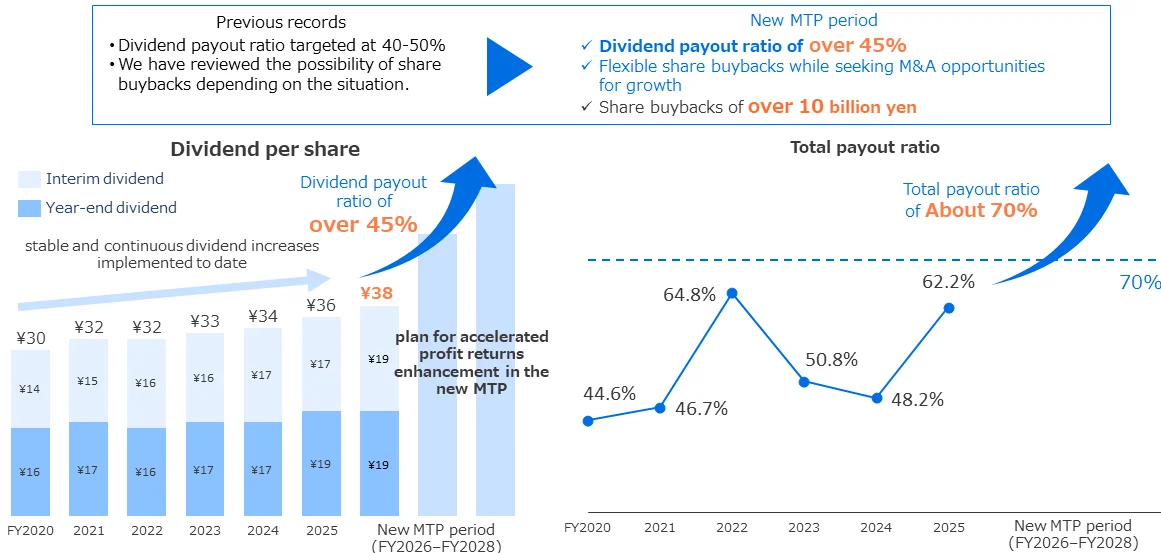
Our company has pursued shareholder returns with a trend of increasing dividends. Over the next three years, we plan to further strengthen this approach and link it to achieving our ROE target.
Specifically, we plan to raise our dividend payout ratio to over 45%, accelerating shareholder returns at a faster pace than before.
In addition, from the perspective of pursuing an optimal capital structure, we plan to acquire more than 10 billion yen of treasury shares over the next three years, aiming for more active and clear shareholder returns.
Through these initiatives, our total shareholder return ratio is expected to reach approximately 70%. We will continue to strive to enhance corporate value so that we can provide long-term value to our shareholders.
You can view the summary of the past six Medium-term management plans.
Past Medium-Term Management Plan PDF
- Announced May 9, 2023
- Announced May 9, 2021
- Announced May 9, 2017
- Announced on June 27, 2014 *
- Announced May 10, 2011
- * Partially revised as of July 14, 2014
- Medium-term management plan 2025 Summary
- Medium-term management plan「Innovation Plan2024 "Design the Future Life"」Summary
- Medium-term management plan「Innovation Plan2020 "JUMP"」Summary
- Medium-term management plan「Innovation Plan2016 "Growing"」Summary
- Medium-term management plan「Innovation Plan2013」Summary
Medium-term management plan 2025 Summary
Result
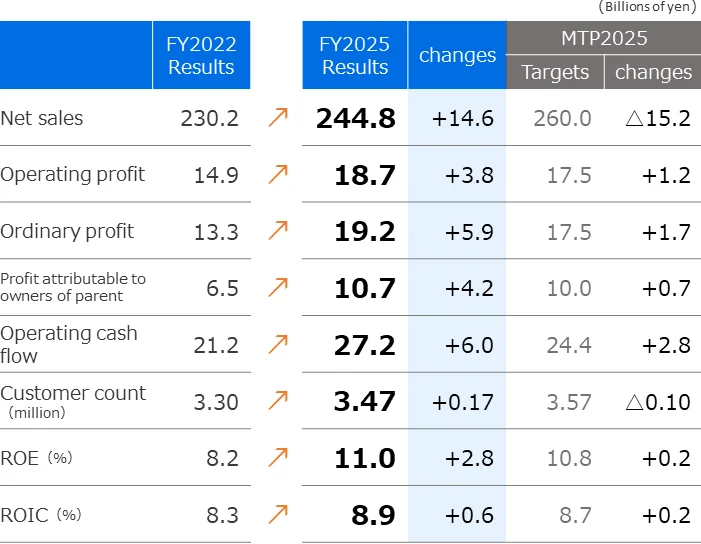
Quantitative Results
FY2025: Record-high sales and profits, significant growth in key management KPIs
Next Stage: Further accelerated business growth and capital efficiency enhancement
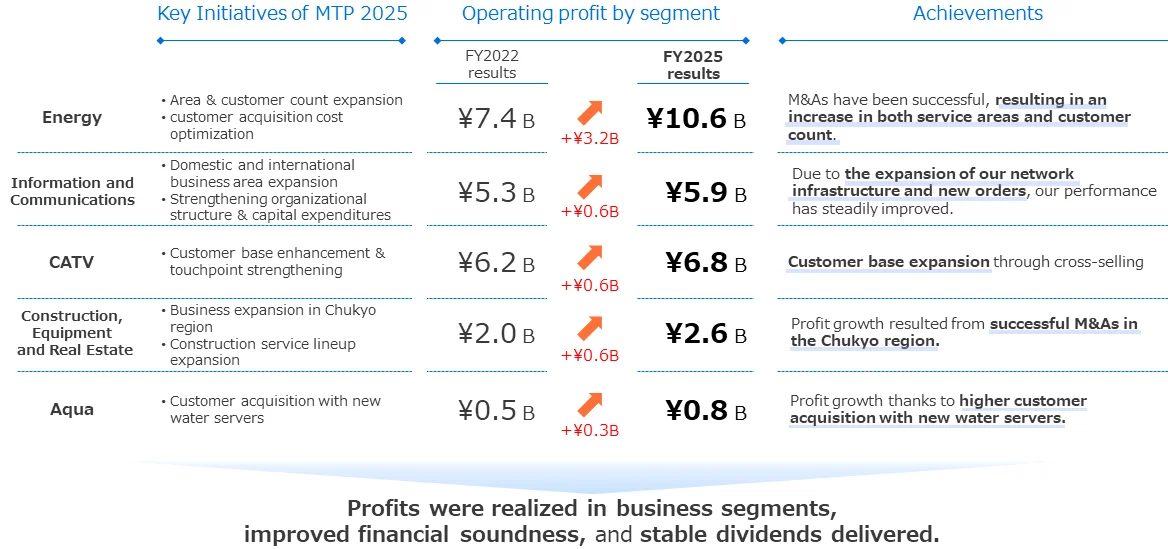
Key Initiatives and Achievements(by segment)
Building on steady profit growth in each segment to drive further group growth
Medium-term management plan「Innovation Plan2024 "Design the Future Life"」Summary
Summary
- Sales increased for the sixth consecutive year. The number of customers will increase by more than 100,000 from the end of fiscal 2021 to 3.3 million
- Excluding the equity method investment loss in Vietnam, etc., capital efficiency maintains a level that meets the expectations of the stock market
- Energy, CATV, and Aqua recorded higher profits due to an increase in the number of customers, and corporate information and communications also performed well
- The main reason for the decline in energy profit is the impact of soaring gas purchase costs (partially due to price pass-through, prioritizing competitiveness)
- Although the number of customers acquired in personal information and communications greatly exceeded the previous fiscal year, acquisition costs increased
Medium-term management plan「Innovation Plan2020 "JUMP"」Summary
Summary
The Innovation Plan 2020 "JUMP" has set challenging goals to give momentum to further growth. We have achieved the plan announced in May 2020, focusing on profits, and believe that we have made steady progress.
Performance of major management indicators
| Values announced in May 2020 | Result | |
|---|---|---|
| Sales (billion yen) | 205.3 | 197 |
| Operating profit (billion yen) | 15.0 | 15.2(↑) |
| Ordinary profit (billion yen) | 14.9 | 15.3(↑) |
| Net income (billion yen) | 8.5 | 8.8(↑) |
| Earnings per share (yen / share) |
64.6 | 67.3(↑) |
| Year-end customer numbers (million) | 3.1 | 3.10 |
Medium-term management plan「Innovation Plan2016 "Growing"」Summary
Theme
- Continue to increase sales by accumulating the number of customers and recover profitability
- Continue to improve our financial position and raise management stability
- Reward shareholders with a continuous and stable return policy
Performance of major management indicators
| 2011/3 Result | 2014/3 Result | 2015/3 Result | 2016/3 Result | 2017/3 Result | |
|---|---|---|---|---|---|
| Number of customers (thousands) | 2,340 | 2,520 | 2,537 | 2,558 | 2,564 |
| Sales (billion yen) | 174.9 | 189 | 187.5 | 180.9 | 178.6 |
| Operating income (billion yen) | 10.8 | 7.4 | 9 | 8.2 | 12.8 |
| Earnings per share (yen / share) |
30.48 | 22.67 | 34.16 | 30.01 | 64.46 |
| EBITDA (billion yen) | 26.3 | 24.9 | 26.2 | 25 | 28.4 |
| Interest-bearing debt (billion yen) | 124 | 85.8 | 73.1 | 71.4 | 54.1 |
| Capital adequacy ratio (%) | 7.7 | 21.6 | 25.7 | 25.6 | 34.5 |
Main initiatives of major businesses
- LP gas business
Information sharing of retail business (gas, aqua, information, security, remodeling, insurance) is used to acquire new customers.
Expand the customer base centering on highly profitable detached houses.
- City gas business
Actively develop fuel cells (ENE-FARM) for household demand.
Promote a cogeneration system for industrial demand. Also for steam, hot water, and power supply.
- Aqua business
Expand customer target by launching new product "Sarari".
Expand sales through sales channels centered on large commercial facilities with high ability to attract customers.
- Broadband business
Efficiently acquire customers by concentrating sales teams on stores with high acquisition efficiency in the sales channels of 230 major consumer electronics mass retailers nationwide.
- CATV business
Expand new broadcasting customers with a collective bulk broadcasting basic free plan + additional services.
Expanded telecommunications customers by leveraging alliances with mobile phone carriers (smartphone discount).
Furthermore, it has penetrated the region by improving service value such as 4K / 8K, broadcasting light, and regional wireless services.
Medium-term management plan「Innovation Plan2013」Summary
Theme
- The holdings system started with the highest priority on improving the financial position
Our mission as a company responsible for social infrastructure is stable management with sound finances.
Summary
- The financial condition has improved significantly. Expansion of shareholders' equity due to an increase in the number of individual shareholders.
- Although the number of customers increased, profits were squeezed due to increased costs due to competition for acquisition. Structural challenges.
Performance of major management indicators
| FYE March 2011 | FYE March 2014 | Progress | |
|---|---|---|---|
| Capital adequacy ratio (%) | 7.7 | 21.6 | ◎ (13.9% Increase) |
| Interest-bearing debt balance (billion yen) | 124.0 | 858 | ◎(38.2bn Decrease) |
| Number of shareholders (people) | 8,132 | 44,590 | ◎ (36,458 people Increase) |
| Number of customers (million) | 2.34 | 2.52 | ◎ (180 thousad Increase) |
| Sales (billion yen) | 174.9 | 189.0 | 〇 (14.1bn Increase) |
| Operating income (billion yen) | 10.8 | 7.4 | × |