Biodiversity Impact Analysis Based on TNFD
①Purpose
Requests for action on the natural environment and biodiversity are growing worldwide.
The TOKAI Group recognizes the interactions between its business activities and the natural environment and biodiversity, and has decided to advance consideration of their conservation and sustainable use.
Through its diverse businesses that touch people’s lives and society, the Group places importance not only on climate change countermeasures but also on harmony with the natural environment and biodiversity, aiming to realize a society in which future generations of children can live with peace of mind.
②Analysis Based on TNFD's*1 LEAP approach
To identify and assess the TOKAI Group’s interactions with natural capital across its business activities, we have commenced an analysis following the LEAP*2 approach recommended by the TNFD.
For this LEAP analysis, we gave priority to five business areas: Energy; Information & Communications; CATV; Construction, Equipment, and Real Estate; and Aqua.
In this phase, we carried out a pilot implementation of the Locate (identifying interfaces with nature) and Evaluate (evaluating dependencies and impacts on nature) steps of the LEAP approach.

- *1TNFD:Taskforce on Nature-related Financial Disclosures — a framework for measuring and disclosing a company’s dependencies and impacts on natural capital.
- *2LEAP :A TNFD-developed methodology for evaluating company interfaces with nature, dependencies/impacts, and nature-related risks and opportunities.
Analysis① Potential dependencies and impacts on nature
We used ENCORE*1 , an analytical tool recommended by TNFD, to analyze our dependencies and impacts on natural capital.
Reviewing the resulting heat map, we identified particularly high dependencies and impacts in the Energy, Construction, Equipment, and Real Estate, and Aqua businesses, and recognized risks such as greenhouse gas emissions and water-quality contamination.
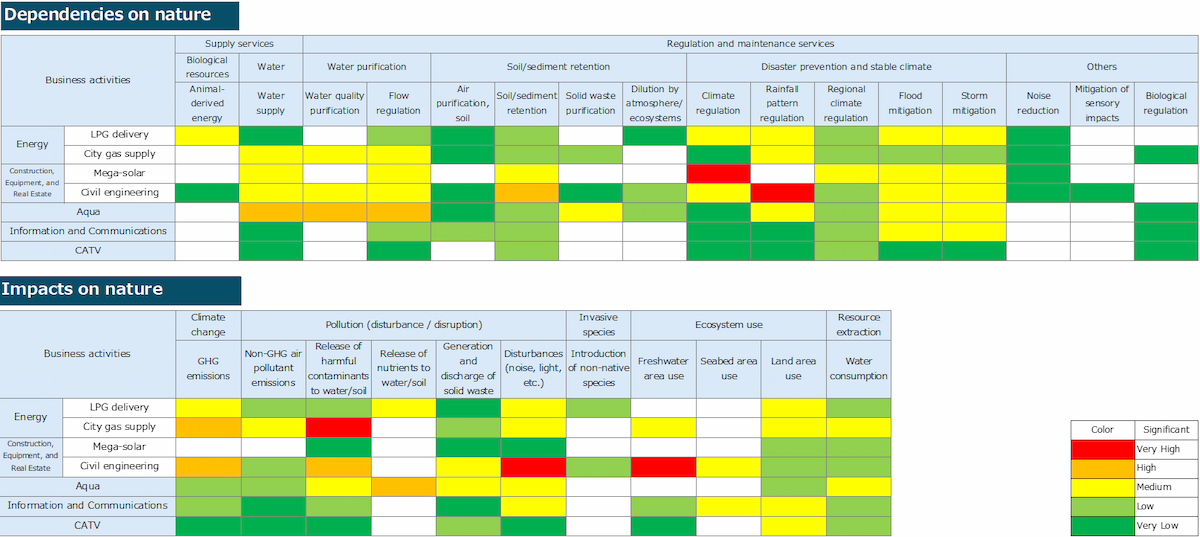
Next, we conducted a value-chain analysis*3 to position the heat-map results within the TOKAI Group’s value chain.
We then carried out a dependencies-and-impacts pathway analysis*4 to understand interrelationships between our operations’ dependencies and impacts on nature and to assemble baseline information for identifying future business risks.
- *1ENCORE: An abbreviation for Exploring Natural Capital Opportunities, Risk and Exposure. an online tool developed by United Nations Environment Programme Finance Initiative (UNEP FI) and partners to analyze and visualize corporate dependencies and impacts on natural capital and associated financial risks.
- *2In the heat map, “cultural services” appeared as a high-dependency item for some businesses, but we confirmed that the relevance was low and therefore excluded it from further consideration in this phase.
- *3Value-chain analysis: organizing upstream and downstream relationships across the Group’s value chain.
- *4Dependencies & impacts pathway analysis: mapping cause–effect flows between business activities and nature.
From the analysis, we recognize that the Energy, Construction, Equipment, and Real Estate, and Aqua business areas tend to show relatively high dependencies on and impacts to nature.
- ●Energy business
【Impacts】
In the city gas production process (Yaizu production facility), we assessed potential impacts including increased greenhouse gas emissions through methane release, and possible effects on terrestrial and aquatic environments.
- ●Construction, Equipment, and Real Estate business
<Mega-solar> 【Dependencies】
Solar power generation is dependent on climatic conditions such as weather, and may be affected by rising temperatures and extreme weather events.
- <Civil engineering>
-
【Dependencies】
Depends on climatic conditions and on ecosystem functions such as soil and sediment retention that prevent landslides and other disasters.【Impacts】
Noise, light, and odor generated during excavation and transport may affect wildlife; changes to topography and water use can lead to habitat degradation.
- ●Aqua business
-
【Dependencies】
In production processes, we rely on ecosystem-provided services (water supply and water quality purification) to secure required water quantity and quality for production and cleaning.【Impacts】
Process wastewater has the potential to cause environmental pollution in nearby soils and water bodies, including nutrient contamination.
Analysis② Interfaces with areas of concern
To understand the relationship between our business sites and the surrounding natural environment, we analyzed interfaces with ecologically sensitive “areas of concern” using the TNFD-recommended assessment perspectives: “biodiversity importance,” “ecosystem integrity,” and “physical water risk.”
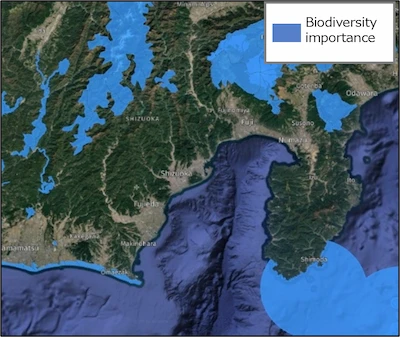
(source: Global Forest Watch)
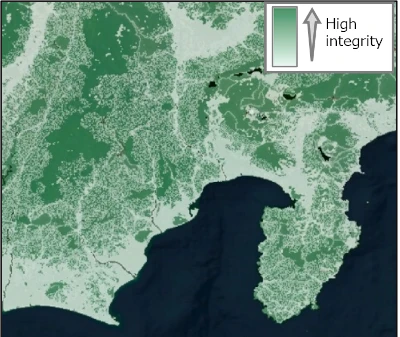
(source: GLOBIO; Beyer et al.)
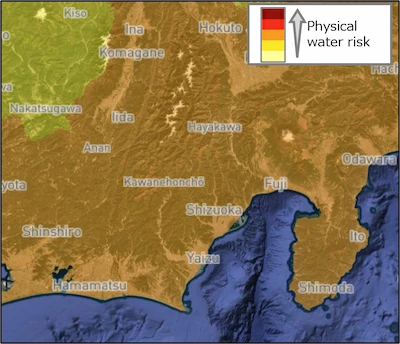
(source: AQUEDUCT)
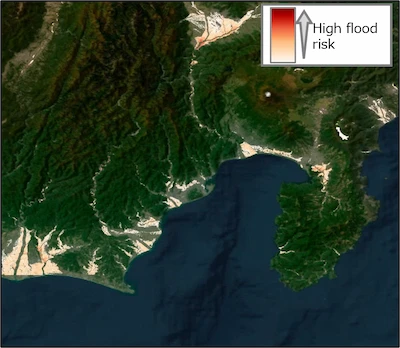
(source: Ministry of Land, Infrastructure, Transport and Tourism, Japan)
- *Data sources used for the analysis
Biodiversity importance: Protected areas, biodiversity importance areas (Global Forest Watch)
Ecosystem integrity: Mean Species Abundance (MSA) (GLOBIO); Ecoregion Integrity Index (ErII) (Beyer et al.)
Physical water risk: water stress (Aqueduct); aggregate water quality index (Water Risk Filter / WWF); flood inundation depth (MLIT, Japan)
The analysis confirmed that some of the Group’s operational sites are located in regions with natural environments that are potentially vulnerable to impacts from business activities.
- ●Areas of high biodiversity importance
If located near legally designated protected areas or internationally recognized biodiversity-important regions, business activities could affect valuable species and their habitats.
- ●Areas with high ecosystem integrity
In regions with intact or rapidly declining ecosystem integrity, business activities may affect remaining native environments and ecosystems.
- ●Areas with high physical water risk
Business water use may affect local water resources; conversely, water scarcity or flooding may impact operations. Business activities may also affect local water quality.
③Current initiatives and future plans
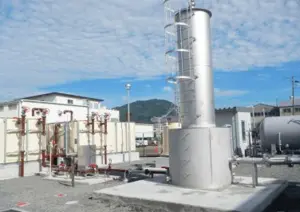
In response to the finding in Analysis ① (potential dependencies and impacts on nature), we recover methane gas that emerges from a hot-spring well supplying Yaizu City and — rather than venting it to the atmosphere — collect and utilize it as a feedstock for city gas, thereby contributing to mitigation of global warming.
In the civil engineering business, we have established policies and targets that give due consideration to quality, the environment, and safety in order to conserve the natural environment, and our employees and partner contractors work together to implement them.
In the Aqua business, which depends on nature, we comply with governmental standards for allowable water extraction to maintain water volumes. We also neutralize cleaning water to appropriate concentrations before discharge to reduce impacts on the natural environment.
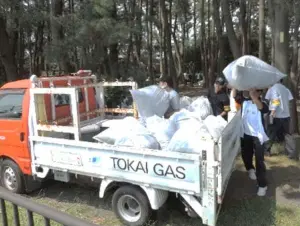
For sites identified as being within or near protected areas in Analysis②, we conduct business with consideration for ecosystem impacts. Beyond those specific sites, we contribute to nature conservation through activities such as coastal disaster prevention forest cleanups and other volunteer activities in Yaizu City, mountain cleanups at Mount Fuji, and initiatives for forest carbon credits.
The TOKAI Group will continue to strengthen further analyses and countermeasures based on these results. We will also continue our ongoing community-based environmental conservation activities to promote biodiversity conservation and to reduce our impacts on nature.