Human Capital Management Policy
Implementing human capital strategies ("Risou no ko" (ideal individual) and "Risou no soshiki" (ideal organization)) to improve employee wellbeing
- *We regard each employee as an asset, which is why we refer to employees as human capital and not human resources.
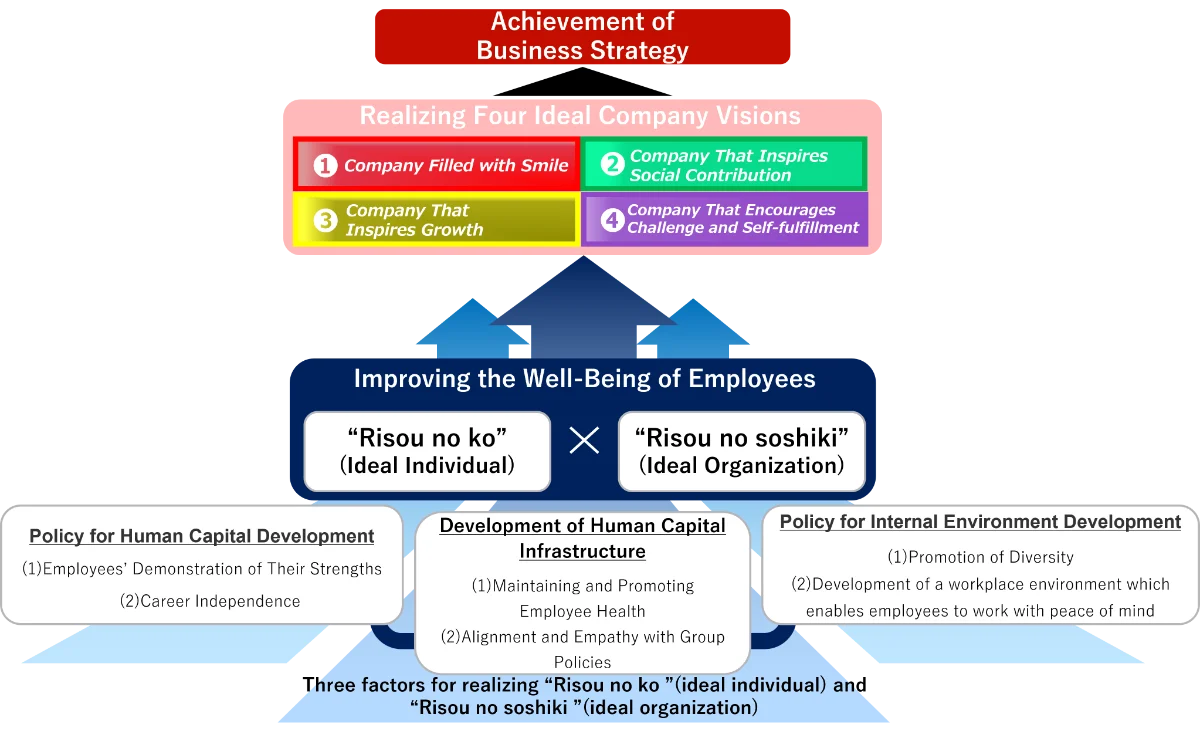
The Group is investing in human capital, aiming to realize its vision of the "Risou no ko" (ideal individual) and its vision of the "Risou no soshiki" (ideal organization). For the realization of our ideals, we are focusing on employees demonstrating their strengths, career independence, promoting diversity, developing workplace environments that enable employees to work with peace of mind, encouraging and enabling employees to maintain good health, and instilling the Group's policies so that employees share them.
For the period of the Medium-Term Management Plan 2028, we have set "Create a future with smiling people who take on challenges" as a guideline for our human capital strategies. Based on this guideline, we have detailed our direction and values regarding our four company visions.
Four company visions
(1) A company where everyone, including ourselves and those around us, is working with a smile
(2) A company where everyone can feel that they are contributing to society by supporting the company
(3) A company where everyone is able to feel that they are developing personally
(4) A company that supports employees in their taking on challenges and striving to achieve self-actualization
By clarifying our direction through our four company visions and setting the "Risou no ko" (ideal individual) and "Risou no soshiki" (ideal organization) visions, we help individual employee understand their role, the actions they are expected to take, and the required direction of growth so that they can improve their skills voluntarily and take on new challenges. At the same time, we are implementing workplace environment assessment, development and improvement and other personnel measures to establish an environment that enables employees to demonstrate their capabilities with peace of mind.
We aim to implement these initiatives to improve the well-being of each individual employee and fully energize the entire organization.
Our two ideal visions
- "Risou no ko" (ideal individual)
Our vision of the "Risou no ko" (ideal individual) is an employee who adapts to environmental change, is constantly striving for self-improvement, and is capable of autonomously advancing his or her career in order to achieve personal goals for enjoyment and satisfaction in life.
- "Risou no soshiki" (Ideal organization)
We aim for an organizational culture with high levels of engagement and team productivity whereby employees regardless of level of seniority cooperate with each other to solve issues through healthy conflict and flexible thinking for the achievement of goals.
Our main KPIs
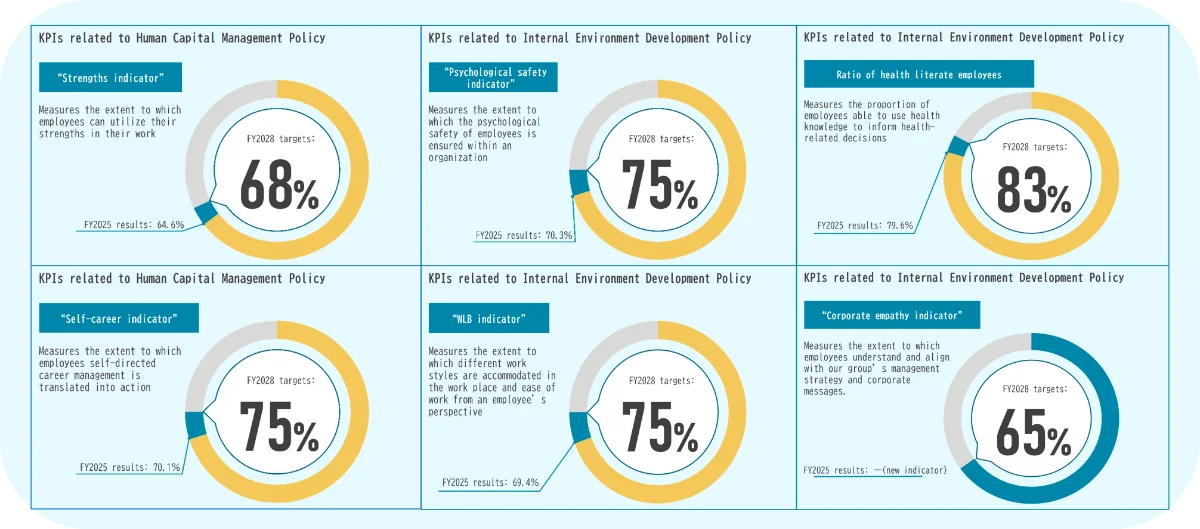
We have adopted the following six indicators for the realization of our "Risou no ko" (ideal individual) and "Risou no soshiki" (ideal organization) visions.
We aim to improve employee well-being by enabling them to be more independent and building a comfortable workplace.
We will enhance our human capital to "Create a future with smiling people taking on challenges," to achieve our indicator and targets.
Strategy
Policy for human capital development
The Group positions "(1) Employees' demonstration of their strengths" and "(2) Career independence" as two important factors in the realization of the "Risou no ko" (ideal individual). We will commit to human capital development that will enable individual employees to develop independently.
(1) Employees' demonstration of their strengths
Every employee demonstrating their strengths leads to the organization as a whole achieving goals. Accordingly, we will allocate human capital appropriately, provide employees with training opportunities, and support them in their taking on challenges, so that our diverse human capital can fully demonstrate their strengths.
(2) Career independence
Enabling employees to make self-directed career choices leads to their own personal development. Accordingly, we will provide them with opportunities to choose career paths and engage in a dialogue with them to enable them to establish careers based on their orientation and strengths. By doing this, we will support our employees in their independent development of their careers and their active participation in the Group over the long term.
Policy for internal environment development
The Group positions "(1) Promotion of diversity" and "(2) Development of a workplace environment which enables employees to work with peace of mind" as two important factors in the realization of the "Risou no soshiki" (ideal organization). We will commit to creating the internal environment to enable our human capital to demonstrate their capabilities.
(1) Promotion of diversity
We are promoting the diversity of our human capital, as we believe it is a source of our competitiveness. To enable our diverse human capital to demonstrate their capabilities regardless of their age, nationality, gender, gender identity, sexual orientation or other attributes, we will establish workplaces with a high level of psychological safety, where everyone can express their opinions and take on challenges with peace of mind, and develop an organizational culture that leverages diversity.
(2) Development of a workplace environment that enables employees to work with peace of mind
To enable diverse human capital to demonstrate their capabilities with peace of mind, we value the improvement of people's work-life balances and are implementing initiatives to develop comfortable workplace environments, including the promotion of flexible work styles and enhancing support for people to balance work and their personal lives. With these initiatives, we are striving to build an environment that enables individual employees to continue working with peace of mind in alignment with their life stage and to fully demonstrate their capabilities.
Development of human capital infrastructure
The TOKAI Group believe that two factors are important in its infrastructure for the realization of the "Risou no ko" (ideal individual) and the "Risou no soshiki" (ideal organization): "(1) Promoting and enabling employees to maintain good health" and "(2) Initiatives to instill the Group's policies so that employees share them." We will press ahead with initiatives to realize them by developing and strengthening this human capital infrastructure.
(1) Promoting and enabling employees to maintain good health
A state in which individual employees are able to continue to work with enthusiasm in good physical and mental health will drive the sustainable growth of the Group. Accordingly, we will promote health and productivity management, encourage each individual employee to increase their awareness of health and establish an environment that will enable them to continue to work in sound physical and mental health.
(2) Initiatives to instill the Group's policies and enable employees to share them
We believe that instilling the Group's policies and enabling employees to share them is an important factor in the development of unity within the organization, and it leads to employees working together to move in the same direction. We will instill the policies and encourage employees to share them by communicating messages from management and enhancing opportunities to engage in dialogue.
Risk management
In pursuing the above human capital strategies, the Group recognizes that issues related to the acquisition and retention of human capital, ensuring diversity and psychological safety, the decline of employee engagement and employees' willingness to share corporate policies and the health of workers are major risks regarding the Group's human capital.
To manage these risks appropriately, the Group has set KPIs related to each item and will continue to monitor and address these risks.
Metrics and targets
| The Group's Important KPI (by fiscal year) |
Results | Targets | ||||||||
|---|---|---|---|---|---|---|---|---|---|---|
| FY2022 | FY2023 | FY2024 | FY2025 | FY2028 | FY2030 | |||||
| KPIs related to Human Capital Management Policy | "Risou no ko" (ideal individual) | Particularly important KPI | (1)"Strengths indicator"*1 | 56.5% | 58.2% | 62.9% | 64.6% | 68.0% | 70.0% | |
| (2)"Self-career indicator"*1 | 65.2% | 65.6% | 68.7% | 70.1% | 75.0% | 80.0% | ||||
| KPIs related to Internal Environment Development Policy | "Risou no soshiki" (ideal organization) | Particularly important KPI | (3)"Psychological safety indicator"*1 | 62.7% | 66.2% | 69.1% | 70.3% | 75.0% | 80.0% | |
| (4)"WLB indicator"*1 | 62.2% | 64.5% | 68.6% | 69.4% | 75.0% | 80.0% | ||||
| Important KPI | (5)Ratio of female managers | 1.4% | 2.1% | 2.2% | 3.0% | 7.0% | 10.0% | |||
| Ratio of female employees*3 | 25.0% | 26.2% | 29.7% | 28.8% | 30.0% | 30.0% | ||||
| Ratio of employees taking childcare leave | Male | 69.6% | 58.6% | 58.2% | 76.8% | 100.0% | 100.0% | |||
| Female | 100.0% | 100.0% | 100.0% | 100.0% | 100.0% | 100.0% | ||||
| KPIs related to the development of human capital infrastructure | Particularly important KPI | (5) Ratio of health literate employees *2 | 68.1% | 70.4% | 77.9% | 79.6% | 83.0% | 85.0% | ||
| (6)"Corporate empathy indicator"*2 | - | - | - | - | 65.0% | 68.0% | ||||
| Other KPI | "Risou no ko" (ideal individual) | Important KPI | Operating profit per employee *2 | 3,250,000 yen | 3,280,000 yen | 3,400,000 yen | 3,720,000 yen | 15%+ (vs. 2025) |
- | |
| Retention of human capital *4 | 97.1% | 97.1% | 97.0% | 97.4% | 98.0% | 98.0% | ||||
| Acquisition of midcareer talent (advancement of human capital) *5 | 34.5% | 34.6% | 35.1% | 36.4% | 45.0% | 50.0% | ||||
| "Risou no soshiki" (ideal organization) | Acquisition of human capital *6 | 95.3% | 128.3% | 110.0% | 158.5% | 100.0% | 100.0% | |||
| Ratio of midcareer hires *7 | 48.5% | 63.1% | 54.9% | 46.4% | 60.0% | 65.0% | ||||
| Ratio of paid leave taken*8 | 67.4% | 69.9% | 72.3% | 74.6% | 78.0% | 80.0% | ||||
- *1The ratio of positive responses to engagement survey questions is used as an indicator.
- *2Covers employees of the Company and all its consolidated subsidiaries
- *3Includes employees of the Company, TOKAI Corporation, TOKAI Communications Corporation, TOKAI Cable Network Corporation, TOKAI Gas Corporation, and TOKAI Management Service Corporation.
- *4Employees remaining at the end of the period/Number of employees at beginning of period
- *5Employees Ratio of mid-career hires to total number of employees in management positions
- *6Employees Actual number of hires (including new graduate and mid-career hires) /Planned number of hires at beginning of period (including new graduate and mid-career hires)
- *7Employees Ratio of mid-career hires to total number of new hires each fiscal year
- *8Period of aggregation: each year, from January 1 to December 31; includes employees of the Company, TOKAI Corporation, TOKAI Communications Corporation, TOKAI Cable Network Corporation, TOKAI Gas Corporation, and TOKAI Management Service Corporation.